Adjusted Stock Basis: Your Real Cost Per Share
See how collected premiums lower your effective cost basis on every stock you own.
Why adjusted basis matters
The whole point of the wheel is that every premium you collect lowers what you effectively paid for your shares. Adjusted Stock Basis does that math for you, so you always know your real break-even — not just what the broker shows.
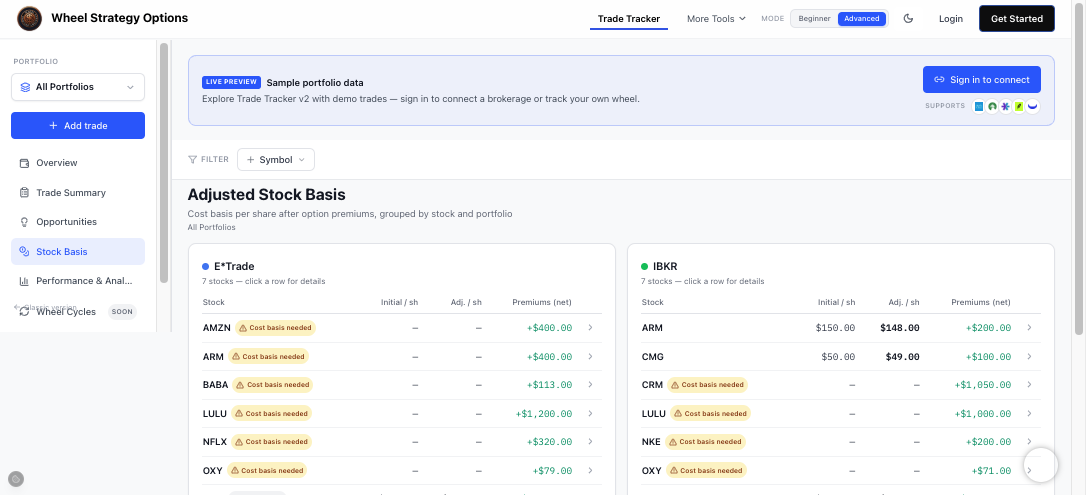
Reading the table
Stocks are grouped by portfolio (each broker gets its own card). For every symbol you'll see:
- Initial / sh — your original cost per share (before option credits).
- Breakeven — cost per share after subtracting premiums on shares you still hold.
- Total income — cash outcome on that ticker: option premiums + realized capital G/L + dividends (when included).
A row marked "Cost basis needed" means the tracker has premium data but doesn't yet know your share purchase price — add it so the adjusted number can be calculated. Click any row for the full breakdown.
Detail panels
Expand a row to see two panels:
- Adjusted cost basis — share cost minus premiums that apply to the lot you still hold (premiums shown as credits). This is your break-even math.
- Total income — all cash outcomes on that ticker, including prior called-away cycles. Premium credit on the left and total premium on the right often differ because one is scoped to current holdings and the other sums every cycle.
Use Include dividends (default on) to count broker-synced dividends in total income. Turn it off if you want premium + capital G/L only. Dividends do not reduce adjusted cost basis — they stay in the income panel.
Set your cost basis
For manual holdings, use the row's action to enter your average purchase price. For synced accounts, the basis usually comes from your broker, but you can override it if a transfer or corporate action threw it off.
A quick example
Buy 100 shares at $148 and later collect $200 in premiums against them, and your breakeven drops to $146/share. Keep selling calls and it keeps falling — that's the wheel compounding in your favor.
Frequently Asked Questions
What does 'Cost basis needed' mean?
It means the tracker knows the premiums you've collected on that stock but not the price you paid for the shares. Add your average cost (via the row's action) and the adjusted cost per share will be calculated automatically.
Does adjusted basis include assignments?
Yes. Premiums from puts that were assigned and calls written against the resulting shares all flow into the net premium that reduces your effective cost per share.
Do dividends reduce my adjusted cost basis?
No. Dividends are cash income and appear under Total income when Include dividends is on. Only option premiums reduce adjusted cost basis / breakeven.
Why is Stock Basis different from Wheel Cycles numbers?
Stock Basis is your adjusted cost per share after premiums (break-even for holdings) plus total income on the ticker. Wheel Cycles measures performance of a CSP → assignment → covered call run over time. Same ticker can show different figures because one is share-cost math and the other is cycle P/L — use both together, not as duplicates.