Find covered calls and cash-secured puts by asking
How I look for covered calls and cash-secured puts by asking. Beginner questions, expert filters, unusual volume, options flow, and GEX.
Quick answer: Open Options AI Assistant and ask for covered calls or cash-secured puts in a normal sentence. It runs the wheel screen, drops contracts with no real market, and ranks what is left. If your question needs it, the same chat can check unusual volume, options flow, or gamma exposure. You still choose the contract and send the order at your broker.
Disclaimer: This is how I look, not a recommendation to sell any contract. Size to the cash and the shares you actually have. Read the strike and the expiration before you do anything. A chat can misread a question, and a quote can be stale.
What you are asking it to do
You run a wheel. You want a put you could sell against cash, or a call you could sell against shares you already hold. Not every contract on the board.
Options AI Assistant is pointed at covered calls and cash-secured puts. The ranking is already on. So is liquidity cleanup, which drops wide spreads and dead quotes unless you ask for them. A follow-up like "only the ones above 2% yield" keeps the earlier rules and tightens them. It does not start over.
Here is the honest list of what it can pull, because I do not want you guessing:
- The wheel screen: covered calls and cash-secured puts, with the filters you would set by hand. Days to expiration, yield, delta, IV rank, volume, open interest, spread, sector, earnings, and a cash budget on puts.
- IV and IV rank for one ticker, plus the highest IV and highest IV rank lists when you do not have a name yet.
- The stock price, so a "$50 stock" question is a real price check.
- Unusual options: contracts whose volume or open interest is far above that contract's own last 30 days. Same idea as the unusual volume page.
- Gamma exposure for a ticker: the regime, and the call wall and put wall. Same read as the GEX page. It can attach that to a screen so you are not hopping tickers one by one.
- On Maxx, the live options tape: individual prints, sweeps and blocks, unusual prints on that tape, a summary for one ticker, and who led the session. That is the options flow page, asked in a sentence.
It will do the arithmetic. "I have $40,000 for puts" can come back as how many contracts fit and what the premium adds up to. It will not tell you which row to sell. That choice stays yours.
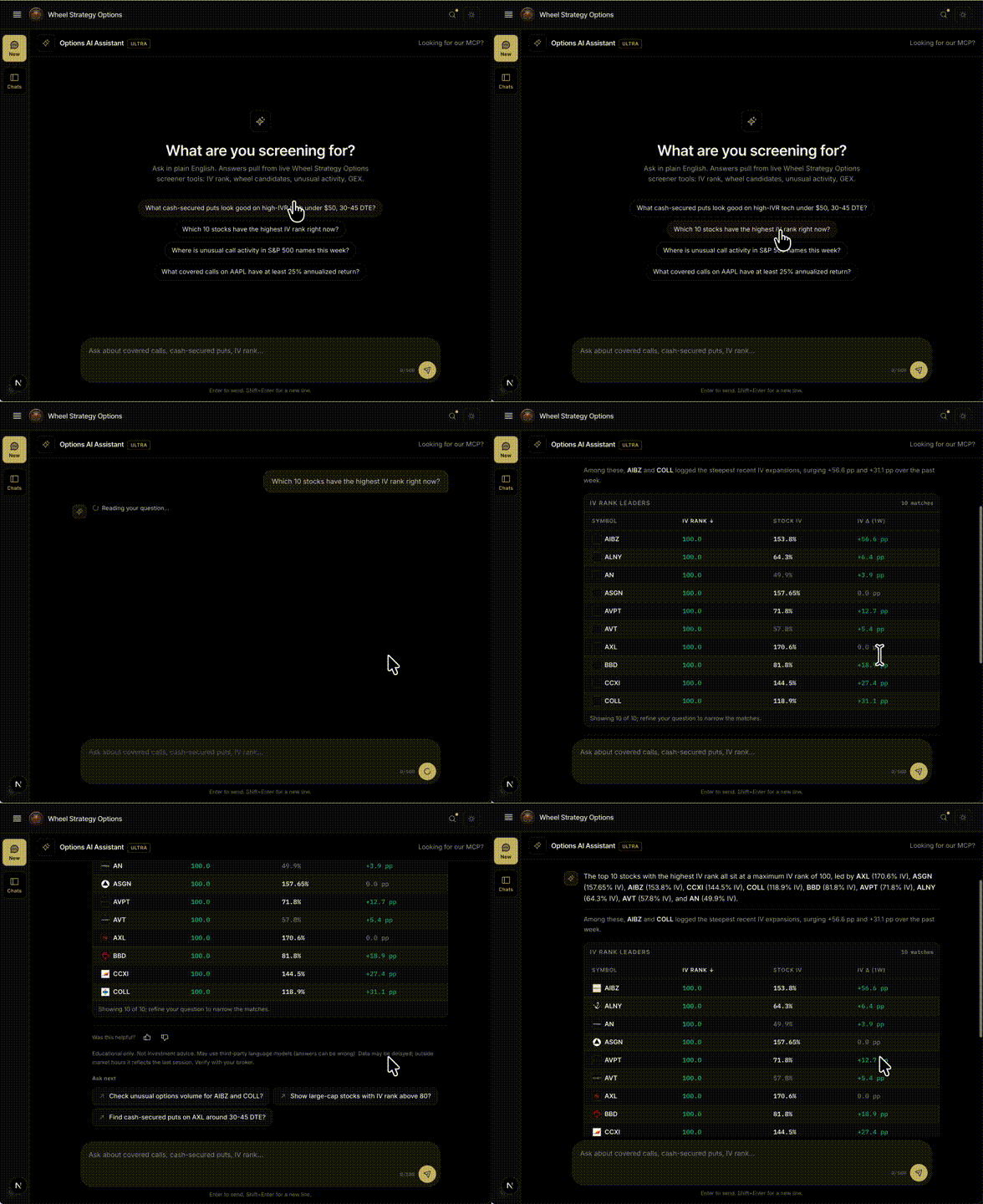
If you do not know the filters yet
A lot of people open the assistant because the screener has more knobs than they want to learn on a Tuesday night. That is a fine reason. You do not need delta, IV rank, or open interest memorized before the first question.
Ask for the trade you understand, plus one limit you actually have. Cash. A share price. A week. Paste one of these and read what comes back before you add anything:
- High IV-rank cash-secured puts under $50
- Covered calls worth selling this week
- Wheel candidates with earnings this week
Take the first one apart, because the words are doing real work.
"Cash-secured puts" means you are looking at puts you could sell, and if you are assigned you are buying the stock. The cash to secure one contract is the strike times 100. A $50 stock keeps that number under $5,000. That is why the price cap matters more, at the start, than a fancy delta band.
"High IV rank" is not "high IV." IV rank is where today's implied volatility sits inside that stock's own last year. High means the premium is rich for that stock. A quiet stock at the top of its own range can be a better wheel name than a wild stock that always looks expensive. If you want the list with no ticker in mind, the IV rank leaderboard is the same ranking. I would start there, not on raw IV.
What you should see is a short table: symbol, strike, expiration, days left, premium, yield. If you did not ask for delta, do not be surprised when delta is not in the first view. Ask for it if you want it. "Add delta and IV rank" is enough.
Then narrow it in the same chat. "Skip anything with earnings in the next two weeks, and keep it around 30 to 45 days." It should remember the $50 cap and the puts. You just did the part that used to mean opening the filter drawer.
Two asks that sound similar and are not. "Wheel candidates with earnings this week" finds names that report. "Skip earnings" keeps you out of that week. Say which one you mean. If you are new, skip the report. You can learn assignment without also learning a gap.
If a number is new, ask in the same thread. The short guide is there when you want the map.
A simple look, start to finish
Here is the order I would use if I were sitting next to you and you had never sold a put.
- Ask for high IV-rank cash-secured puts under $50. Read five rows. Ignore the rest.
- Check that you could buy 100 shares at that strike without stretching. If the cash is not there, the yield does not matter.
- Say "drop earnings inside two weeks, 30 to 45 days."
- Ask "which of these has unusual volume versus its own last month?" You are not looking for a hero trade. You are checking that you are not the only person in the contract, and that today's volume is not a one-off you do not understand.
- If you still like one, sell it at your broker for the premium you actually see, not the number you remember from the chat.
- Log the fill in Trade Tracker. That is the book. The assistant is the next contract, not the scoreboard.
If you already know the trade
You do not need a tour. You need the sorting done. Say the rules you already sell with.
A question I would actually type:
Tech cash-secured puts, 30 to 45 DTE, delta 0.20 to 0.30, IV rank over 50, open interest at least 500. I have $40,000.
That one sentence is a full screen. Puts only. A sector. A time window. A delta band. Rich premium versus each stock's own year. A real market, because open interest of 500 is a stand-in for "someone else is already there." And a cash cap, so a $400 stock never shows up and wastes the row.
On a cash number, the interesting columns are how many contracts the cash covers and what the premium adds up to if you sold that many. That is math. It is not a suggestion to sell the full size. I still sell smaller than the max when the name is new to me.
Covered calls are sized off shares, not off a cash pile. "I have 100 NVDA, 100 META, and 100 GOOG. Show covered calls, 30 to 45 days, delta under 0.30." Name every ticker in the same question. Otherwise the richest premium wins the whole list and your other shares never appear. If one name dominates, say "three contracts per symbol."
Then change one rule, not the whole question. "Same list, annualized return at least 20%, nothing inside 14 days." If it forgets the tickers or the cash, paste them again. Do not argue with a chat that dropped a constraint. Correct it.
Those are the same filters as the covered call screener and the cash-secured put screener. I open the screens when I want every column and a saved set. I use the assistant when I want the first pass in one sentence, or a screen plus IV rank plus a gamma read together.
Unusual volume and options flow are not the same look
Unusual volume is the contract versus itself. Today's volume, or today's open interest, is far above that contract's own last 30 days. A name that usually trades 200 contracts and prints 2,000 is unusual even if nobody on social has mentioned it. Ask: "Cash-secured puts under $50 where volume is unusual versus the last month." You get a wheel-shaped table, plus a score for how far out of line the activity is. That scan is available in the assistant the same way the screen is. The unusual volume page is the same scan when you want to browse it.
Options flow is the tape. One print at a time. Someone lifted the ask, it was a sweep or a block, the premium was large, the read is bullish or bearish. Ask: "Largest call sweeps in NVDA today" or "Where is the bullish flow in single stocks this session?" That tape, the unusual prints on it, a one-ticker summary, and the session leaders are Maxx. If your plan does not include the tape, the assistant should say so. It should not invent a sweep.
I use them in that order when I am about to sell premium.
First the screen, because I need a put or a call I can actually sell: a strike, a date, a bid, a cash number. Then unusual volume, because I want to know if this contract woke up versus its own history. Then, if I am on the tape, flow, because a sweep tells me someone paid up to open. A high volume score with no aggressive prints is a different story from a sweep through the ask. Neither one is a reason to sell. Both are reasons to look harder before I do.
A practical pair of questions, not a mashup:
- "Puts I would wheel on high IV rank under $50, 30 to 45 days."
- Then, on the two names you kept: "Any unusual volume versus the last 30 days, and any large call sweeps today?"
If the flow is a pile of deep in-the-money calls, I treat that as stock replacement or a hedge, not as a bet on the stock. The tape will show distance from the money if you ask. "Drop anything more than 5% in the money" is the sentence.
When I bother with GEX
Gamma exposure is about the stock, not about which put pays the most. I ask when the expiration is short, or when the name is the kind that pins. "What is GEX on SPY this week?" is enough.
What I want back is simple. Is the regime positive, where dealer hedging tends to sell rallies and buy dips, or negative, where moves can extend? Where is the call wall, and where is the put wall? If the strike I was about to sell sits on the put wall, I want to see that before I do it.
A 45-day put on a quiet stock does not need this. Do not add GEX to every question to feel thorough. Add it when the map could change the strike you pick.
You can also ask for the screen and the gamma read together. "Same puts, and tell me the gamma regime for each name over that same window." That keeps the regime lined up with the expirations you are actually selling, instead of a 0DTE picture stapled onto a monthly put. The GEX page is still the place when you want the strikes drawn out.
What to ask, and what you should get back
| What you ask | What it looks at | What "good" looks like |
|---|---|---|
| High IV-rank cash-secured puts under $50 | Wheel screen, price, IV rank | A few puts. Cash per contract under $5,000. Premium rich versus that stock's own year. |
| Covered calls on AAPL, at least 25% annualized, 30 to 45 days | Wheel screen, your ticker, annualized return | Calls on AAPL only. The return column is there because you asked for it. |
| I have 100 shares of three names. Show calls. | Wheel screen, a cap per ticker | Every name shows up. Not one ticker repeated down the page. |
| I have $40,000 for puts. | Wheel screen plus the cash math | Only puts the cash can secure. A count of contracts and the premium total. |
| Unusual volume versus the last month | The contract versus its own 30 days | A score, not a story about a sweep. |
| Largest call sweeps today | The live tape (Maxx) | Prints, with side and size. If you are not on Maxx, a straight "this needs Maxx," not a made-up tape. |
| GEX on SPY this week | Gamma for that window | Regime, call wall, put wall. Not a contract to sell. |
Where this sits next to the rest of the product
The assistant is not a second database. It drives the same covered call and cash-secured put screens. Unusual volume, options flow, and GEX stay their own pages, and the chat can call them in the same breath as a screen. That used to be five tabs.
Trade Tracker is the other half. After you sell, log the fill there: premium, assignment, the next call against the shares. If you ask "how much have I made this year," the record to open is Trade Tracker. Finding the next put and keeping score are different jobs.
FAQ
Does the assistant sell the option for me?
No. It finds contracts that match the question. You send the order at your broker.
What if I only type "good covered calls"?
You will get a vague list, because "good" is not a filter. Give it one real limit: a ticker you hold, a share price, a cash number, or a week. Then tighten.
Why did contracts I expected disappear?
Liquidity cleanup is on. Wide markets and empty quotes are dropped unless you ask to see them. If you want the junk, say "include illiquid contracts." Most of the time you do not.
Is unusual volume the same as options flow?
No. Unusual volume compares a contract with its own last 30 days. Options flow is the live tape, print by print. Use the first to see that a contract woke up. Use the second, on Maxx, to see whether someone paid the ask to open.
Can it tell me my P&L?
That scoreboard is Trade Tracker. Use the assistant for the next covered call or cash-secured put.
Can I use this if I do not know the Greeks?
Yes. Start with price, cash, and "skip earnings." Add delta later, when you care how far out of the money you are.
What I would do today
Paste one sentence you could explain to a friend. If you are new, use the $50 put question and then cut earnings. If you already have rules, type the rules, including the cash or the shares. Read five rows. If a name looks crowded, ask about unusual volume before you ask about flow. If the put is short-dated, ask about GEX. Then decide at your broker.
The assistant is here.
Comments ()